




VEMP – Vestibular Testing
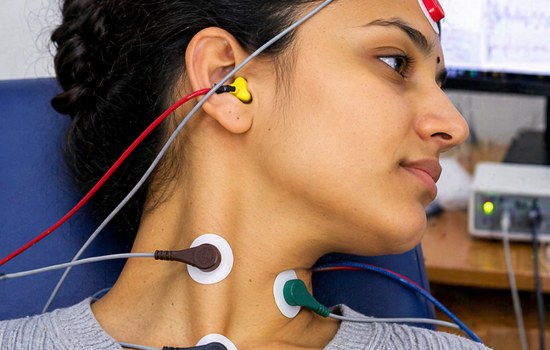
VEMP – Vestibular Testing
The VEMP Test (Vestibular Evoked Myogenic Potential) is an advanced vestibular function test used to assess the otolith organs of the inner ear (saccule and utricle) and their related vestibular nerve pathways. It is highly useful in patients with vertigo, dizziness, imbalance, Ménière’s disease, vestibular neuritis, superior canal dehiscence, and unexplained balance disorders. The test records tiny muscle responses generated after sound stimulation, helping specialists identify which part of the vestibular system is affected.
At our audiology and balance clinic, VEMP testing is performed using advanced computerized vestibular equipment by trained specialists. We commonly perform both:
- cVEMP (Cervical VEMP) → checks saccule + inferior vestibular nerve
- oVEMP (Ocular VEMP) → checks utricle + superior vestibular nerve
How the VEMP Test Works
During the procedure, surface electrodes are placed on the neck muscles and/or below the eyes, depending on whether cVEMP or oVEMP is being performed. The patient hears short loud clicks or tone bursts through earphones, and the machine records the muscle reflex response.
- cVEMP: patient gently turns or lifts the head to activate the neck muscle
- oVEMP: patient looks upward while electrodes record eye muscle responses
The test helps evaluate otolith organ function and vestibular nerve integrity. It is safe, painless, non-invasive, and usually completed in 15–20 minutes.
Benefits of VEMP Testing
- Detects otolith organ dysfunction
- Differentiates saccular vs utricular disorders
- Useful in Ménière’s disease diagnosis
- Helps detect superior canal dehiscence
- Supports vestibular neuritis assessment
- Improves vertigo diagnosis accuracy
- Useful before vestibular rehabilitation
FAQ – VEMP Vestibular Testing
VEMP is a special vestibular test that checks the balance organs of the inner ear by recording muscle responses to sound.
No, the test is completely safe, painless, and non-invasive.
The test usually takes 15 to 20 minutes.
cVEMP checks the saccule and lower vestibular nerve, while oVEMP checks the utricle and upper vestibular nerve.
Yes, it is very useful in evaluating Ménière’s disease, endolymphatic hydrops, and otolith dysfunction.