




Electrocochleography
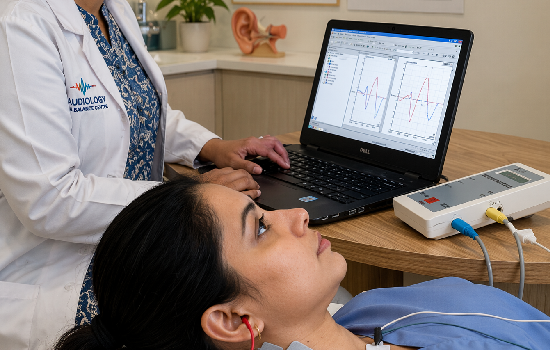
Electrocochleography (ECochG)
Electrocochleography (ECochG) is an advanced electrophysiological hearing test used to measure the electrical responses generated by the cochlea (inner ear) and auditory nerve when sound is presented. It is highly useful for diagnosing Ménière’s disease, endolymphatic hydrops, auditory neuropathy, cochlear disorders, and complex vestibular symptoms such as dizziness with fluctuating hearing loss. The test provides objective information about inner ear pressure and cochlear nerve function, making it an important tool in modern audiology.
At our audiology and vertigo clinic, ECochG is performed using advanced computerized equipment by experienced audiologists and ENT specialists. It is especially recommended for patients with recurrent vertigo, ear fullness, tinnitus, fluctuating hearing loss, and suspected inner ear fluid imbalance.
How the Test Works
During the procedure, a soft electrode is placed in the ear canal or near the eardrum, along with surface electrodes on the forehead. Clicking sounds or tone bursts are delivered through earphones, and the machine records the summating potential (SP) and action potential (AP) generated by the cochlea and auditory nerve.
The SP/AP ratio is then analyzed to detect abnormal inner ear fluid pressure, which is commonly seen in Ménière’s disease and endolymphatic hydrops. The test is safe, painless, minimally invasive, and usually completed in 20–30 minutes.
Benefits of Electrocochleography
- Helps diagnose Ménière’s disease
- Detects inner ear fluid imbalance
- Objective cochlear function testing
- Useful for vertigo patients
- Supports tinnitus evaluation
- Helps auditory nerve assessment
- Safe and reliable diagnostic procedure
FAQ – Electrocochleography
Electrocochleography is a specialized test that records the electrical activity of the inner ear and auditory nerve in response to sound.
No, the test is generally safe and painless. Some patients may feel mild ear canal pressure because of the electrode placement.
The ECochG test usually takes 20 to 30 minutes.
It helps diagnose Ménière’s disease and endolymphatic hydrops, which are common causes of vertigo and fluctuating hearing loss.
Yes, it is one of the most useful tests for identifying abnormal inner ear fluid pressure associated with Ménière’s disease.