




Dix Hallpike Test
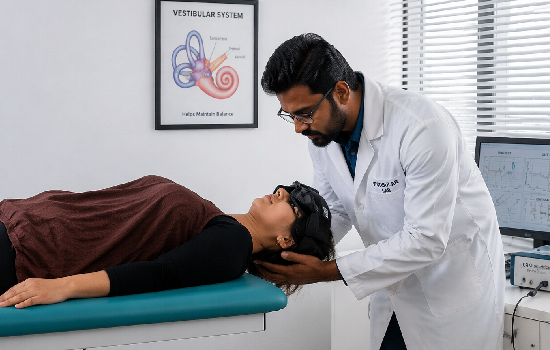
Dix Hallpike Test
The Dix Hallpike Test is the gold-standard positional test used to diagnose Benign Paroxysmal Positional Vertigo (BPPV), especially when the posterior semicircular canal is involved. It helps specialists identify whether tiny displaced inner ear crystals (otoconia) are causing vertigo symptoms during head movement. The test works by placing the patient in specific head and body positions to trigger the characteristic spinning sensation and eye movements (nystagmus) associated with BPPV.
At our audiology and vertigo clinic, the Dix Hallpike test is performed by trained specialists using clinical observation or VNG goggles for precise detection of nystagmus. This helps us identify the affected ear and canal, allowing immediate treatment planning with the Epley or Otolith Reposition Maneuver.
How the Test Works
During the procedure, the patient starts in a sitting position. The specialist turns the head 45° toward one side and quickly helps the patient lie back with the head slightly extended. The eyes are carefully observed for torsional nystagmus and vertigo response.
The test is then repeated on the opposite side to compare both ears. A positive result means the patient experiences vertigo and the specialist observes nystagmus, confirming BPPV on the affected side. The test is safe, quick, and usually completed in 5–10 minutes.
Benefits of Dix Hallpike Test
- Gold-standard BPPV diagnosis
- Identifies affected ear
- Quick chairside test
- Non-invasive and painless
- Helps immediate treatment planning
- Useful before Epley maneuver
- Accurate vertigo assessment
FAQ – Dix Hallpike Test
It is a diagnostic positional test used to confirm BPPV by triggering vertigo and observing eye movements.
No, the test is safe and non-invasive, though it may cause temporary dizziness for a few seconds.
The Dix Hallpike test usually takes 5 to 10 minutes.
A positive result means BPPV is likely present, and the affected ear can be identified based on the nystagmus response.
After a positive result, doctors usually perform the Epley Maneuver or Otolith Reposition Maneuver for immediate relief.