




ASSR
ASSR Test (Auditory Steady State Response)
The ASSR Test (Auditory Steady State Response) is an advanced objective electrophysiological hearing test used to estimate frequency-specific hearing thresholds. It measures how the auditory nerve and brainstem respond to rapid continuous sound stimuli, helping specialists accurately determine the degree and configuration of hearing loss, especially in newborns, infants, young children, and patients who cannot respond to behavioral hearing tests. It is highly valuable for severe to profound hearing loss assessment and hearing aid or cochlear implant planning.
At our audiology and hearing care center, ASSR testing is performed using advanced evoked potential systems by experienced audiologists. The test provides a detailed estimated audiogram at 500 Hz, 1 kHz, 2 kHz, and 4 kHz, making it more frequency-specific than routine click-based tests in many cases.
How the ASSR Test Works
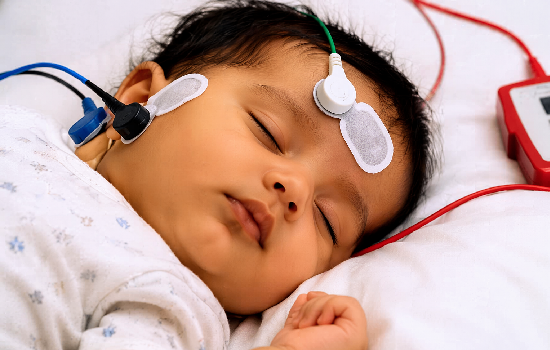
During the procedure, small electrodes are placed on the forehead and behind the ears, and earphones deliver rapid modulated tones at different frequencies. The machine records the brain’s electrical response and automatically estimates the hearing threshold for each tested frequency.
The patient should remain asleep or very still, which is why it is ideal for babies and sleeping children. In some cases, mild sedation may be advised for active children.The test is safe, painless, non-invasive, and usually completed in 30–60 minutes.
Benefits of ASSR Test
- Frequency-specific hearing threshold estimation
- Ideal for infants and young children
- Useful in severe to profound hearing loss
- Helps hearing aid programming
- Supports cochlear implant planning
- Objective and highly reliable
- Safe and painless procedure
FAQ – ASSR Test
ASSR stands for Auditory Steady State Response, an objective hearing test that estimates hearing thresholds at different sound frequencies.
Yes, the BERA test is completely safe, painless, and specially designed for babies and infants.
The test usually takes 30 to 60 minutes, depending on the number of frequencies tested and the child’s sleep condition.
BERA/ABR mainly evaluates neural pathway responses, while ASSR provides more frequency-specific threshold estimation, making it highly useful for hearing aid and cochlear implant planning.
Yes, ASSR is especially useful in moderate, severe, and profound hearing loss estimation.