




Acoustic Reflex Test
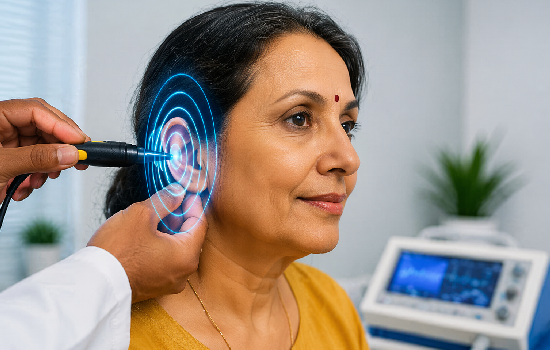
Acoustic Reflex Test
The Acoustic Reflex Test is an important middle ear and auditory pathway assessment used to evaluate how the stapedius muscle in the middle ear responds to loud sounds. When a strong sound is presented, this tiny muscle contracts automatically to protect the inner ear from excessive sound energy. The test helps specialists assess the middle ear, auditory nerve (8th nerve), facial nerve (7th nerve), brainstem reflex pathways, and retrocochlear disorders. It is commonly performed along with Impedance Audiometry and Tympanometry for a complete hearing evaluation.
At our audiology and hearing care center, the acoustic reflex test is performed using advanced immittance equipment by experienced audiologists. It is especially useful for diagnosing facial nerve weakness, auditory neuropathy, otosclerosis, middle ear pathology, and suspected retrocochlear lesions such as vestibular schwannoma.
How the ASSR Test Works
During the procedure, a soft probe is placed in the ear canal to create a seal, similar to tympanometry. A loud tone is then presented either:
- Ipsilaterally → sound and recording in the same ear
- Contralaterally → sound in one ear, recording in the opposite ear
The machine measures the change in middle ear compliance caused by contraction of the stapedius muscle. In some cases, a reflex decay test may also be performed to check whether the reflex can be sustained for 10 seconds, which helps detect retrocochlear pathology. The test is safe, painless, non-invasive, and usually completed in 5–10 minutes.
Benefits of Acoustic Reflex Test
- Evaluates middle ear muscle reflex
- Helps diagnose facial nerve disorders
- Supports auditory nerve assessment
- Useful in retrocochlear screening
- Detects otosclerosis and middle ear stiffness
- Quick and painless procedure
- Improves hearing loss diagnosis accuracy
FAQ – Acoustic Reflex Test
It is a middle ear reflex test that checks how the stapedius muscle contracts in response to loud sounds.
No, the test is completely safe, painless, and non-invasive.
The test usually takes 5 to 10 minutes.
Reflex decay helps detect retrocochlear disorders like vestibular schwannoma or auditory nerve lesions.
Yes, it is very useful for evaluating facial nerve (7th nerve) and stapedius muscle function.