




Saccades Test
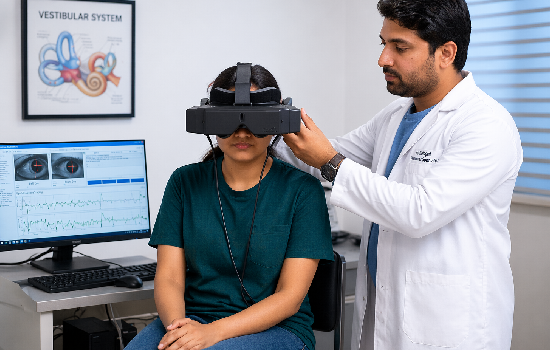
Saccades Test
The Saccades Test is an important oculomotor and central vestibular assessment used to evaluate how quickly and accurately the eyes move from one target to another. These rapid eye movements are called saccades, and they play a key role in gaze shifting, reading, visual scanning, and maintaining stable vision. In vestibular and neurotology clinics, this test is commonly performed as part of the VNG/ENG oculomotor battery to assess central nervous system pathways, brainstem function, cerebellar control, and vestibulo-ocular coordination.
At our audiology and balance clinic, the saccades test is performed using advanced VNG goggles and computerized eye-tracking systems. It is especially useful for patients with dizziness, vertigo, imbalance, suspected central vestibular disorders, neurological dizziness, and visual motion sensitivity.
How the Test Works
During the procedure, the patient wears VNG infrared goggles and looks at targets that appear at random positions on a screen. The patient is asked to shift the eyes quickly toward each target without moving the head.
The software measures:
- Latency – reaction time of eye movement
- Velocity – speed of the eye movement
- Accuracy – whether the eyes overshoot or undershoot the target
- Symmetry – equal performance in both directions
Abnormal findings such as slow velocity, delayed latency, hypermetric or hypometric saccades may suggest central vestibular or neurological involvement. The test is safe, painless, non-invasive, and usually completed in 5–10 minutes.
Benefits of Saccades Test
- Detects central vestibular disorders
- Useful for VNG oculomotor screening
- Helps identify cerebellar dysfunction
- Supports brainstem pathway evaluation
- Quick and non-invasive
- Improves dizziness diagnosis accuracy
- Useful in neurotology assessment
FAQ – Saccades Test
It is an eye movement test that checks how quickly and accurately your eyes jump from one target to another, mainly to assess central vestibular pathways.
No, the test is completely safe, painless, and non-invasive.
The test usually takes 5 to 10 minutes.
It helps detect central nervous system, cerebellar, and brainstem-related balance disorders.
Abnormal results may suggest central vestibular dysfunction, cerebellar disease, neurological dizziness, or impaired eye movement control.