




OAE Hearing Screening
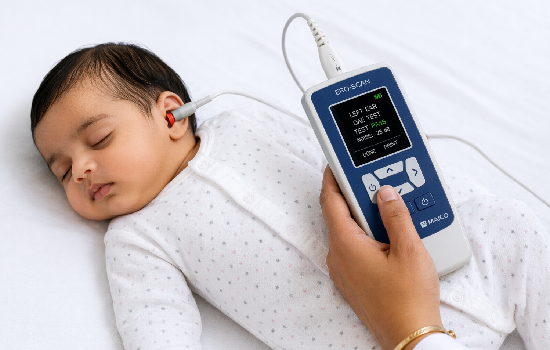
OAE Hearing Screening (Otoacoustic Emissions)
Optical Plaza offers OAE Hearing Screening, also known as the Otoacoustic Emissions Test is a fast, non-invasive hearing test that uses a sensitive microphone to detect sound waves generated by the patient’s cochlea and reflected by the outer hair cells. The OAE Hearing Test is suitable for newborns, infants, toddlers, and individuals who cannot communicate effectively.
This hearing test is usually recommended for the initial screening of hearing abilities in newborns and young children. It is a convenient way to check hearing capability in patients who are unable to provide accurate responses to standard hearing tests. Additionally, it is suggested for hearing screening in newborns and children with delayed speech and suspected hearing problems.
At our audiology and hearing care center, we offer the OAE Hearing Screening in Pitampura. Our qualified audiologists conduct this test using advanced digital equipment to ensure accurate results. Therefore, you can rely on our team to identify hearing problems early and allow your child to receive professional treatment to restore hearing capabilities and speech pattern.
How the OAE Test Works
A small, flexible probe is inserted into the ear canal during an OAE hearing test in Pitampura. This probe emits clicking noises or other sounds and captures echoes generated by the inner ear’s cochlea. We will offers .
If the hair cells in the cochlea are not damaged, the devices are typically able to detect a response. This test is often quick to perform, taking two to five minutes per ear, and is painless and non-invasive, making it especially well-suited for young children and even sleeping babies. We also offer bera test; click here to know more.
Benefits of OAE Hearing Screening
- Helps detect hearing problems at an early age
- Suitable for newborns and infants
- Quick, painless, and non-invasive
- Does not require an active response from the child
- Helps assess cochlear function
- Useful for newborn hearing screening
- Supports evaluation of speech and language delays
- Helps guide further hearing assessment when required
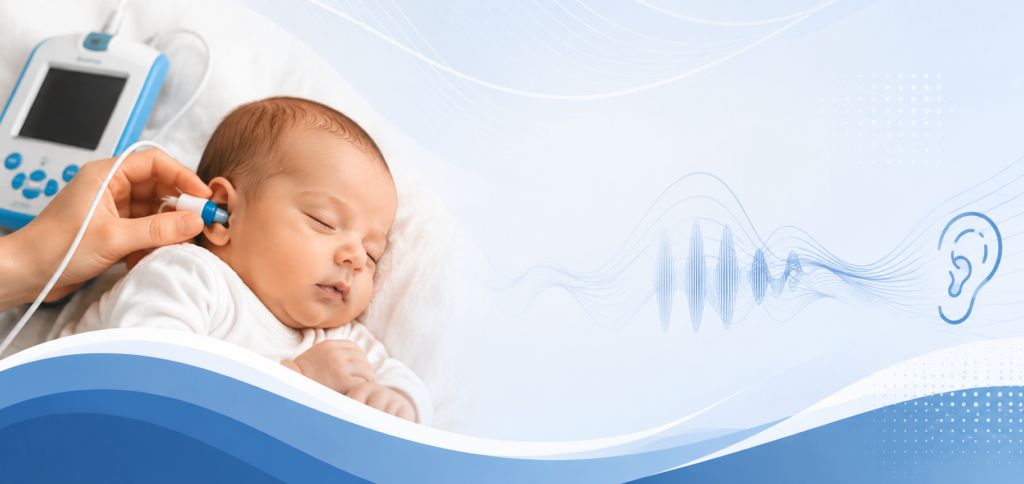
Why Is OAE Hearing Screening Important for Babies?
Early hearing screening is important because hearing plays a major role in a child's speech, language, and communication development. OAE Hearing Screening in Pitampura can help identify possible hearing difficulties at an early stage, even when a newborn or infant cannot respond to sounds on their own.
Newborn hearing screening can be done to check if a baby is unable to hear sounds normally. If the OAE test result is abnormal, then the audiologist might want to perform another screening or hearing tests to further observe the child's hearing capacity.
OAE Hearing Test for Speech Delay
- Hearing impairment can sometimes delay a child’s speech and language development. An OAE Hearing Test in Pitampura can help evaluate the function of the cochlea in such cases if a parent notices that their child does not consistently react to sounds, voices, and their name.
- The test is helpful because it is quick and painless. In addition, the procedure does not require a child to cooperate or respond. In some cases, an audiologist can recommend additional diagnostic tests to evaluate hearing abilities.
Who Should Consider an OAE Hearing Test?
An OAE Hearing Test in Pitampura may be useful for:
- Newborns as part of routine hearing screening
- Infants and toddlers who are not able to respond reliably to standard hearing tests
- Children who are suspected to have speech and language delays
- Babies who are at higher risk for hearing problems
- Children who are not responding consistently to sounds and voices
- Patients who need monitoring of cochlear function
- Children who need to be followed up on after initial hearing screening
Conclusion
Early hearing screening can play an important role in identifying possible hearing difficulties, especially in newborns, infants, and young children. An OAE Hearing Test in Pitampura is a quick, painless, and non-invasive way to assess cochlear function and determine whether further hearing evaluation may be needed. At Optical Plaza,
OAE screening is performed using advanced equipment with professional audiology guidance. If you are looking for reliable OAE Hearing Screening in Pitampura, timely testing can help support early evaluation and appropriate hearing car
OAE Hearing Screening checks whether the cochlea is producing normal sound responses when stimulated. It is a quick and non-invasive hearing screening method.
Yes. OAE testing is safe, painless, and non-invasive, making it suitable for newborns and infants.
An OAE test generally takes around 2–5 minutes per ear, although the total time may vary depending on the child and testing conditions.
OAE can help identify problems involving cochlear function, but it does not detect every type of hearing loss. Additional tests, such as BERA/ABR, may be recommended when a more detailed assessment is required.